
 Explore App
How a Boston Periodontist Uses AI Segmentation to Plan Surgery & Turn Patients Into Partners
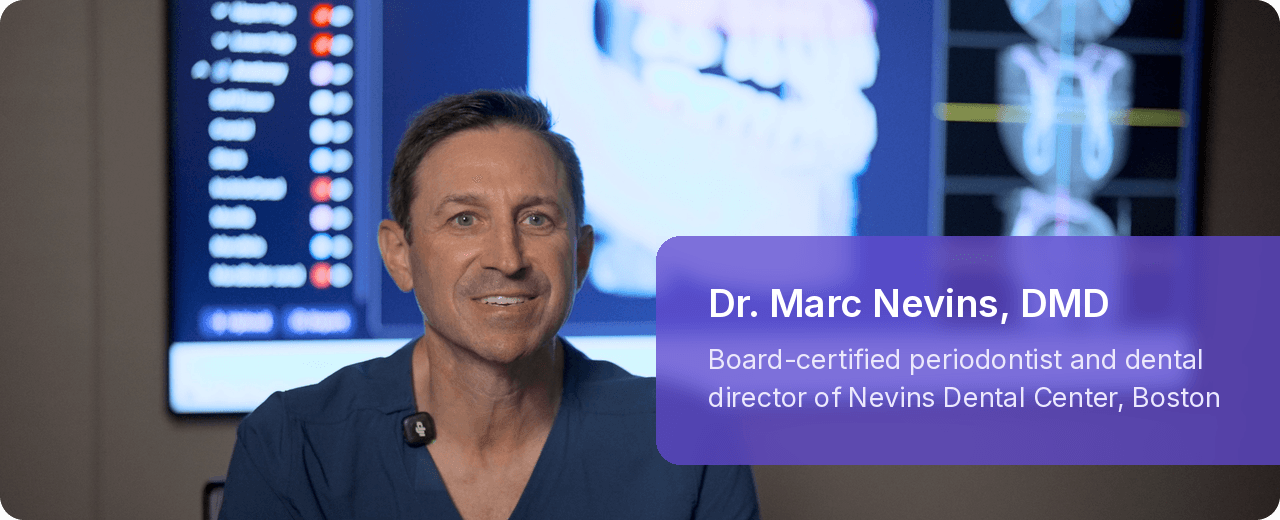
Dr. Marc Nevins is a board-certified periodontist and the dental director of Nevins Dental Center, a multi-specialty practice in downtown Boston where periodontists, prosthodontists, endodontists, oral surgeons, and orthodontists care for patients together under one roof.
He is also one of Diagnocat’s longest-standing clinical partners: his practice has worked with the platform through its research and development phase, and today it runs fully integrated into the practice’s daily workflow; from the first scan to the final consultation note.
We sat down with Dr. Nevins to talk about what that looks like in real patient care.
About Dr. Marc Nevins
Dr. Marc Nevins, DMD | Board-certified periodontist and dental director of Nevins Dental Center, Boston: a multidisciplinary team of dental specialists providing coordinated care. A Diagnocat user since the platform’s research and development phase.
“It was the aha moment for the patient to say, ‘I understand. I can see it. I can really visualize it.’”
When Patients Finally See What You See
Every clinician knows the gap: the problem is obvious on the scan, and invisible to the person it belongs to. “For patients, they’re often intimidated by conventional X-rays,” Dr. Nevins says. On a flat image, bone loss is “very opaque and foreign to them when you try to explain it otherwise.”
A segmented 3D view changes the conversation. Dr. Nevins describes a patient with advanced periodontal disease who understood he had gum problems, but couldn’t grasp the bone loss underneath. “Being able to have a 3D view that lets the patient visualize exactly what is happening with the teeth and the bone in a way they can see makes all the difference in the world. It was this type of view that allowed this patient to understand, to commit to treatment. And we’re able to actually treat and save all of his teeth.”
Show, Don’t Tell: A Tooth Millimeters from the Nerve
In the interview, Dr. Nevins walks through a case that captures it: impacted lower molars sitting deep in the jaw, near the nerve. “Sometimes it’s hard for the patient to understand what the implication of something like this is and what the risks are.”
With the segmentation from the CT scan, he shows the patient exactly how the teeth sit in the jaw, then peels the anatomy back. “Now I can actually remove the jawbone and show the patient how the red nerve is located in relation to the tooth roots. This way I can educate the patient on what my concerns are with how this site might be managed, which otherwise might be hard to understand.”
A Second Set of Eyes on Every Scan
Diagnocat’s FDA-cleared detection of periapical radiolucencies on CBCT acts as a second set of eyes on every scan that comes through the practice. “There are times where things that it highlights are difficult to find on a scan. It might be an obscure, small periapical lesion where there’s varying densities of bone,” Dr. Nevins explains. “The reports are going to highlight those and draw your attention to those, to make sure that we don’t miss anything.”
He confirms every finding himself. The report is a prompt for his eyes, not a replacement for them.
The Appointment, Documented
For the past several months, the practice has also been using Transcriptor, Diagnocat’s AI-assisted consultation notes. The team starts the recording before the doctor enters the room and runs it through the whole appointment; interruptions, imaging, and all. “It’s going to pull the valuable information and put that into a consolidated narrative for you to then review,” Dr. Nevins says. At the end of the visit, the narrative is ready for the clinician to review and build their notes from.
Patients as Partners
Asked what he’d miss most, Dr. Nevins doesn’t pick just one Diagnocat feature, “It’s just part of my workflow today.” But he keeps returning to the same idea: a segmented visual, ready about five or six minutes after the scan, that lets him show patients what’s going on in their own mouths.
“We can co-diagnose with our patients… so they can become a partner in the process of planning and then executing the treatment plan.”
That’s the precision his practice trusts and the clarity his patients understand.
See Diagnocat on your own cases.
Book a personalized demo and we’ll walk through the workflow on the kind of cases you handle.
Some features are pending regulatory approval. Diagnocat is a support tool; all findings are confirmed by the treating clinician. Full product and regulatory information: diagnocat.com/us/legal-info