
 Explore App
How a prosthodontist uses AI to listen better, and help anxious patients feel seen
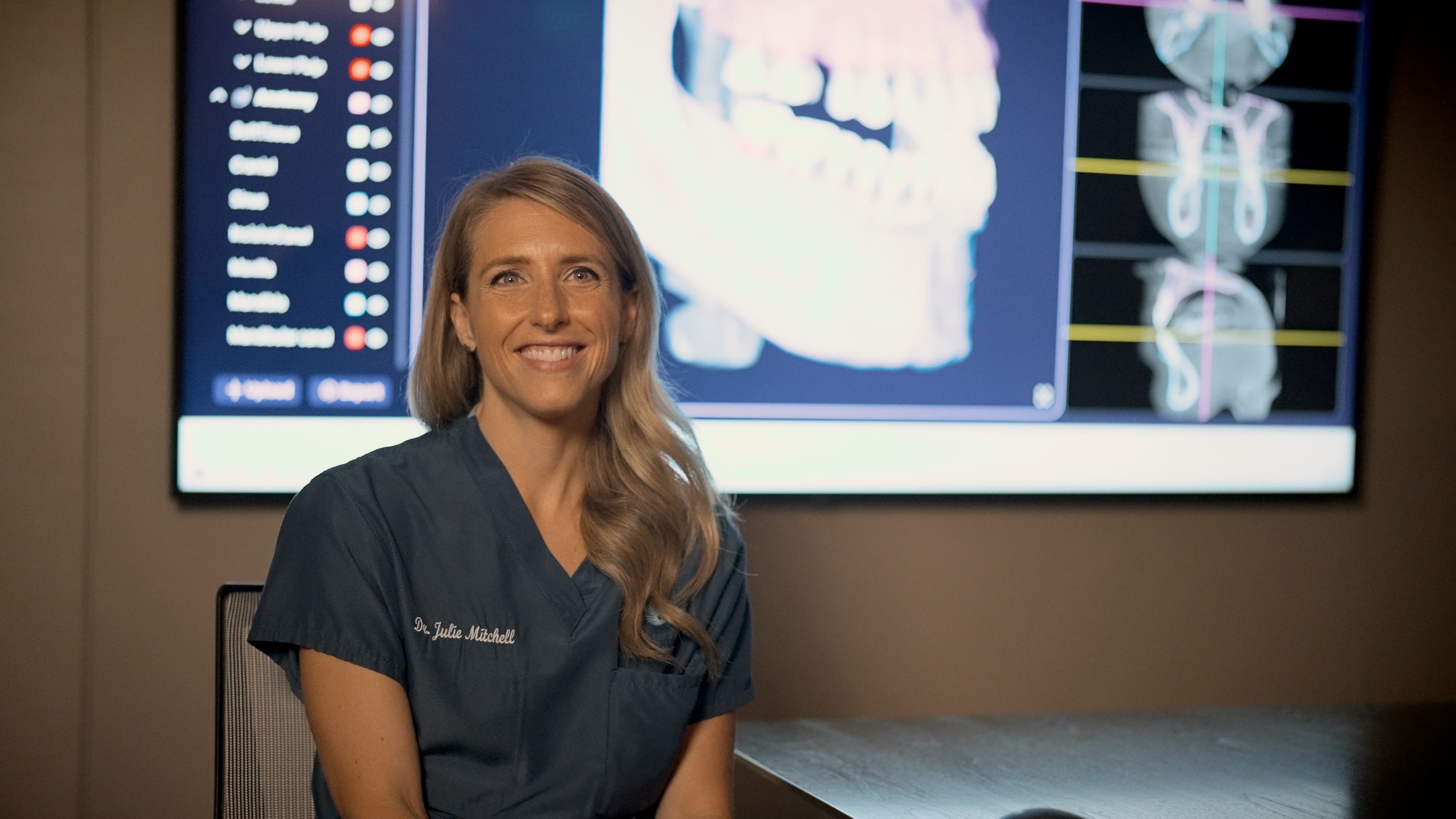
Dr. Julie Mitchell is a prosthodontist at Nevins Dental Center, a multi-specialty practice in downtown Boston where periodontists, prosthodontists, orthodontists, oral surgeons and endodontists care for patients together under one roof.
She’s often the first clinician a patient with a long or complicated dental history may sit down with. Her practice uses Diagnocat daily, weaving AI into the very first visit, through every conversation with the patient, and into the plan they build together.
We sat down with Dr. Mitchell to talk about what that looks like when the patient in the chair is afraid.
About Dr. Julie Mitchell
Dr. Julie Mitchell, DMD | Prosthodontist, Nevins Dental Center, Boston
Part of a multidisciplinary team of dental specialists providing coordinated care. Often the point person for patients with complex needs: previous trauma, congenitally missing teeth, incomplete treatment and failing implants. A Diagnocat user for over two years.
“I could look her in the eye, engage with her, ask follow-up questions, and really help her feel seen by me.”
The point person for complex patients
A prosthodontist rarely gets the simple cases. “As a prosthodontist, I’m often the point person meeting with patients who have complex dental needs,” Dr. Mitchell says. Long dental histories. Previous trauma. Congenitally missing teeth, incomplete treatment, failing implants. The first appointment is mostly conversation, and the conversation is long.
That is where Transcriptor, Diagnocat’s AI-assisted consultation notes, earns its place in her day. “To have a built-in tool that’s able to take the patient interview and put it into a comprehensive note at the end of the appointment is truly invaluable during a busy clinic day.” An hour-long consult becomes one complete note, ready for review.
Honestly? It is not perfect
Dr. Mitchell is candid about the technology. “Of course the Transcriptor is not perfect, but it’s very close to it. It understands dentistry, and gives me an output in a very logical way.”
What matters to her is what it frees her to do. “I’m able to truly engage with my patients, ask them follow-up questions, go off on tangents, get details that normally, if I was using a checklist-style interview, I wouldn’t be able to do.” Before, part of her attention was always on the notes. “I’d be so worried, ‘Hey, am I getting everything?’”
That’s no more: the consultation room, transformed
Dr. Mitchell has used CT scans her entire career. For most of it, explaining them meant black and white slices. “The axial slices, the sagittal slices, pointing to dark spots, trying to triangulate the image for the patient.”
A segmented 3D view changed the conversation. “That’s no more. I’m able to use the 3D scan in a way that patients understand.” The rendering, she says, “really takes me out of the patient’s mouth and it pairs me with the patient as a person.” She can show them missing or misaligned teeth on a representation of their own scan “so they understand their issues completely.”
One patient she won’t forget
A new patient arrived with a history of trauma and a lot of dental fear and anxiety. She did not want anything coming toward her face. So Dr. Mitchell did not start with an exam. “I said to her, ‘Well, let’s start by just talking.’”
With Transcriptor capturing the history, Dr. Mitchell could give the patient her full attention. “I could look her in the eye, engage with her, ask follow-up questions, and really help her feel seen by me.”
Then she brought the CT scan up on the screen and showed the patient her own 3D AI model. “She knew it was an AI output of her CT scan, but what I said to her was, ‘This will help us do the exam on the screen, and then I can confirm the findings with a clinical exam.’”
An hour and fifteen minutes into the consultation, the patient sat in the dental chair. Dr. Mitchell performed the exam and confirmed the findings. “It was not a traumatic experience for her. She left feeling a great sense of trust in me, and I felt great about the partnership that we were forming.”
Everything on one screen
Asked what she would miss most without Diagnocat, Dr. Mitchell does not hesitate. “The 3D AI models. They really allow me to provide a foundation for discussion” as the practice coordinates care across orthodontics, surgery, endodontics and periodontics. The segmented teeth, the segmented bone, the flagged periapical findings: “everything is right there on the screen.”
Every finding is still hers to confirm. The screen is where the conversation starts, not where it ends. “These are the things I see. Let’s confirm the findings and develop a plan.”
That is what feeling seen looks like in her practice: a patient who understands, and a clinician who is fully in the room.
See Diagnocat on your own cases.
Book a meeting with a local specialist and we’ll walk through the workflow on the kind of cases you handle.
Some features are pending regulatory approval. Diagnocat is a support tool; all findings are confirmed by the treating clinician. Full product and regulatory information: diagnocat.com/us/legal-info